Chris Birky

Death taught me how to live.

I’ve been to twelve funerals. I’ve buried both parents and my sister. I walked away from a wreck that should have killed me. All of it before I turned thirty-two. I’ve spent fifteen years learning what pain is actually for — and this page is the whole story, so you know exactly who’s reading yours.

READ IT ↓
15 years
ON MY OWN HEALING PATH
1,000+
CONVERSATIONS AT PEOPLE’S HARDEST MOMENTS
6 years
SEDONA SOUL ADVENTURES — THE COUNTRY’S TOP TRANSFORMATIONAL RETREAT
01 / THE WRECK

At twenty-one, I should have died. Instead, I woke up.

My sister died when I was in eighth grade. Grief had no shape yet — just a pressure I couldn’t name and couldn’t sit still inside of. So I poured it into basketball. The gym was the one place the pressure went quiet, and for years that passed as coping. Then high school ended, the gym went away, and I did what a lot of people do when pain has no language: I tried to drown it. Partying, drinking, harder and harder — chasing feeling nothing. For a while it worked, which is the trap. Numbing feels like relief right up until it becomes the thing that’s killing you.

Then came the wreck. It should have taken my life. It didn’t — and in the space right after, the lights came on all at once. When you come that close to the end, your life reorders itself in an instant. What matters gets loud. What doesn’t goes silent. You don’t come back the same person. It splits your life into a before and an after, and standing in the after I couldn’t avoid the only question that matters: am I living, or am I just surviving?

My first answer was to run. I packed up my life in Indiana and moved to Los Angeles, certain that enough distance would fix what hurt in me. It didn’t, and it took me years to understand why: everywhere you go, there you are. The scenery changed. The wound came with me. That’s what finally pointed me inward instead of outward — and, much later, to Logotherapy and the work that became my life.

WHAT IT LEFT ME WITH

The wreck was the beginning. It’s the crack where the light got in.
02 / THE LETTER TO MY FATHER — 2019

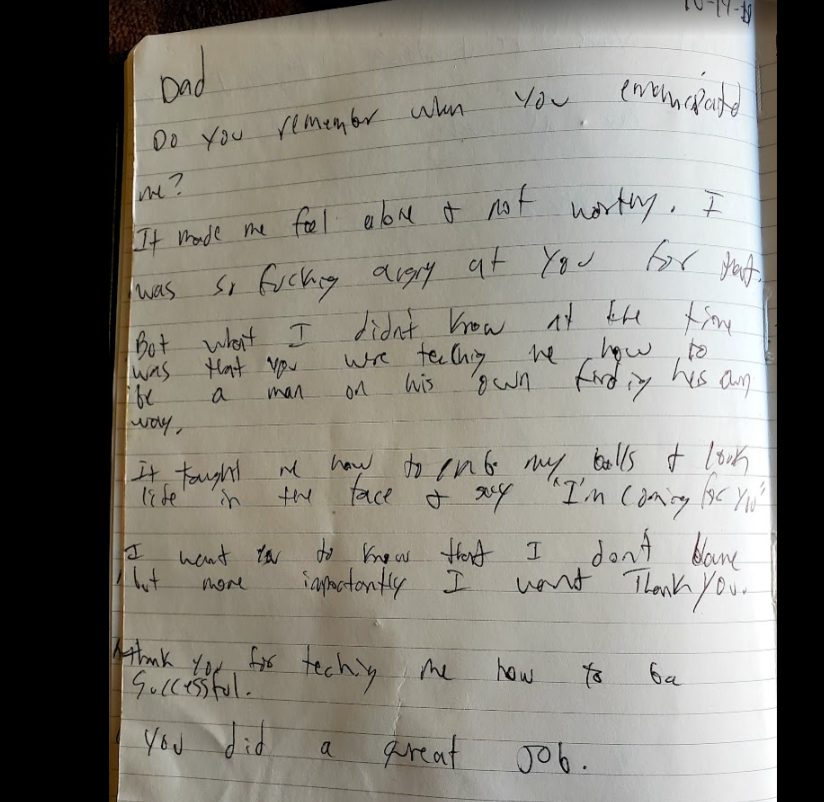
“Dad — do you remember when you emancipated me?”

My father was an alcoholic, and I grew up reading rooms before I walked into them — listening for footsteps to figure out which version of him was coming home. A kid in that house doesn’t get to relax. He stays scanning, half a step ahead, always managing. I didn’t know it then, but I was building the exact skill that would become my life’s work. I just built it out of survival first.

When I wouldn’t live the life he wanted, he emancipated me — legally disowned me as his son. I was so pissed off at him that we didn’t speak for almost five years. I carried the ledger of everything that had happened, believing that holding it kept me safe. It didn’t. It just kept me his — tied to him, defined by him, owned by what he did.

We found our way back to speaking as the alcohol made him sicker. And in 2019, at a men’s weekend in Oakland about fathers and sons, I finally wrote him the letter. Forgiveness — and let me be precise, because almost everyone gets this wrong — is not saying what happened was okay. It wasn’t. Forgiveness is refusing to let the past own the rest of your life. I couldn’t control what happened to me as a boy. I could decide it wouldn’t run the rest of my life.

The Tuesday after, I read the letter out loud to my sister. About an hour later, my father had a heart attack and died.

That same morning, back at work, a quote lit up my phone: “To forgive is to set a prisoner free and discover that the prisoner was you.” — Lewis B. Smedes. And out in the warehouse, where the radio never played anything but reggaeton, the song playing was the one he and I always listened to together — Metallica, “Nothing Else Matters.” I don’t need you to believe anything about that. I just need you to know it happened. I said what needed saying, he was free to go, and he went.

The handwritten letter to my father
THE LETTER, EXACTLY AS I WROTE IT. HE DIED THE MORNING I READ IT OUT LOUD.

The very thing that hurt me became the thing that lets me see. I can read people because I spent a childhood reading him.

03 / MY MOTHER — 2023

She died in my arms. What she left in me took years to see.

She was fifty-seven. A heart attack, no warning. I did CPR for ten, maybe fifteen minutes, but the oxygen never reached her brain, and by the time it was over she was already gone. That’s not a memory I “processed” and filed away. It went into my body. It lives in me.

Here’s the detail that still stops me: she passed two months after I completed the deepest healing work of my life. Two months. As if life turned around and asked — are you actually going to use what you just learned, or was that all talk? At her celebration of life I was the steadiest person in the room. Not numb. I grieved her fully — but with clarity instead of collapse. The work held. That’s how I knew it was real.

There’s a second layer that took longer to see: inheritance. She didn’t just hand me her love. She handed me her patterns — the fear, the bracing for the next bad thing, the way of surviving she learned from her parents, who learned it from theirs. Nobody does this on purpose. You hand someone your conditioning the way it was handed to you — still warm, before you ever got the chance to look at it.

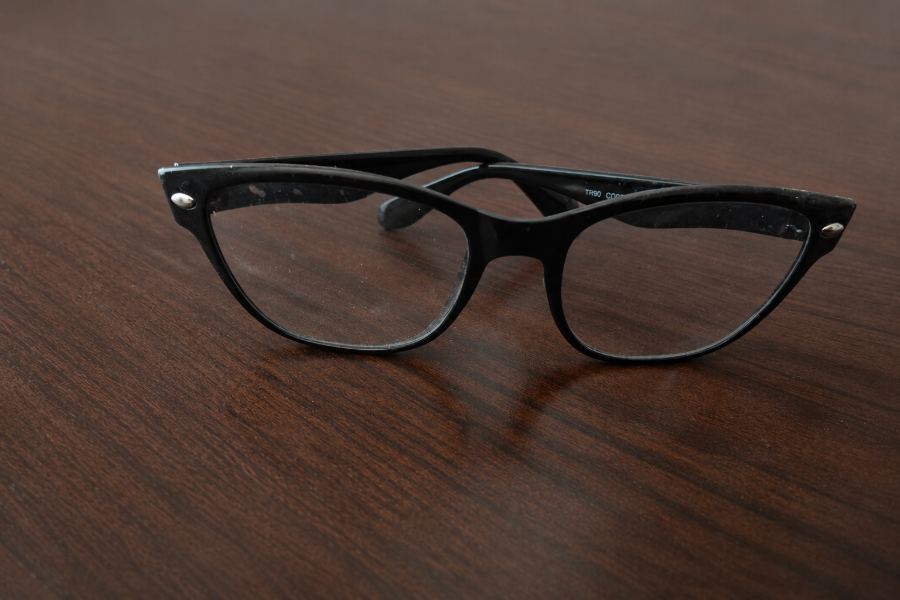
After she passed, something guided me to her dresser — I won’t argue about what. Her glasses were in one of the drawers, and I felt her ask me to take them out and put them on. So I did, and I still do. When things get cloudy — when I catch the old wiring running, the fear, the inherited flinch — I put them on and remember whose eyes I’m choosing to see through. She loved me unconditionally. That was her whole mission: to show me how to live that way so I could hand it to others. The pattern ends with me. The love doesn’t.

THE INSIGHT

Some of what runs you was never yours. It was handed to you, still warm.

My mother's glasses
HER GLASSES. WHEN THINGS GET CLOUDY, I PUT THEM ON.
04 / THE BODY KEEPS THE SCORE

“What are you grieving, son?”

For years I carried giant knots in my shoulders. Rock hard. I told myself it was sports — old injuries, the price of an athletic body. That was the story that didn’t require me to feel anything.

Then a practitioner put his hands on my shoulders, felt what was there, and asked a question I wasn’t ready for. Not “does this hurt?” He asked: “What are you grieving, son?”

It traced straight back to my sister. When she died, I looked around at a family drowning and appointed myself the little fixer — my shoulders are big enough to carry this. So I carried everyone’s grief on top of my own, for years, because I believed that’s what I was for. I never grieved. I managed.

Unprocessed grief doesn’t evaporate because you ignored it. It goes somewhere. Mine went into my shoulders — literally — and calcified into knots I mistook for muscle. That’s not a metaphor. It was in my actual tissue.

WHY THIS CHANGED EVERYTHING

You cannot think your way out of something your body is holding. Insight without the body is a really smart way to stay exactly where you are.

05 / THE CASCADE — HOW ONE WOUND BECOMES A PERSONALITY

One small sentence built the whole machine.

My root wound was “not good enough.” That was the fuel. Everything else was smoke. Watch how it cascades — this is the clearest map I have of how a single wound becomes an entire personality.

01
“Not good enough.”

The sentence a kid decided was true. The fire under everything that followed.

02
Fear of abandonment.

If I’m not enough, people will eventually see it and leave. So build a defense against being left.

03
People-pleasing.

Read what everyone needs and become it. Stay useful, stay agreeable, give no one a reason to walk away.

04
Codependency.

Run long enough, pleasing hardens: my entire sense of okayness outsourced to how other people felt about me.

05
Self-sabotage.

The cruelest turn: blow up the good relationships. Leave before being left. Better to hold the knife than to feel it.

The behaviors were never the problem. They were smoke. You can fight smoke forever — fifteen strategies for fifteen symptoms — and end up exhausted and still stuck, because the fire’s still burning. Name the wound, and the symptoms lose their grip all at once.

And here’s how it actually resolves, because I don’t sell fairy tales: the voice is still in there. I can hear “not good enough” whisper on a hard day. What changed is that I can hear it without obeying it. That’s not being cured. That’s being free.

06 / CHASING MY TAIL — THE PSYCHEDELIC YEARS

I tried to buy my breakthrough.

When I was desperate to get unstuck, I did the whole menu — ayahuasca, psilocybin, bufo. I chased the medicine hard. And I want to be careful here, because I’m not anti-medicine: some of it cracked me open in ways nothing else had. The first time I ever cried — really cried — was on ayahuasca. Think about that. A grown man who’d buried his sister and survived the childhood I survived, and the first tears finally came out under plant medicine.

So of course I chased it. I thought if the crying happened there, the healing lived there — I just needed more of it. That was the mistake. I’d have a massive opening, feel reborn for a week, and slide right back into the same patterns, because I’d mistaken the doorway for the destination. The medicine kept showing me the room. I kept refusing to move in and do the actual furniture-moving.

THE LESSON — ROOT BEFORE TOOL

Without the foundation, the breakthrough can’t hold — you’re pouring water into a cup with no bottom. The experience was never the cure. It was an invitation. The work was always going to be the work.

07 / WHAT THE YEARS TAUGHT ME

Everything I believe, I paid for.

When death visits you once, it’s an event. When it keeps coming — funeral after funeral — it becomes a language. And once you speak it, you can’t un-hear what it’s been saying: this is not a rehearsal. I’d give back every lesson to have them all back. That deal was never on the table. The deal was: learn this, or waste it.

Life is not waiting for you to be ready.

Twelve funerals taught me that “someday” is the most expensive lie we tell ourselves. Death shows you whether you’re living or just surviving. Not someday. Now.

You’re not broken. You’re patterned.

My root wound was “not good enough.” It bred fear of abandonment, then people-pleasing, then sabotaging good things before they could leave me. I thought that was my personality. It was a survival pattern on autopilot — and the day I saw it as a pattern instead of an identity, it lost its grip.

Pain doesn’t transform you. Meaning does.

Pain can just as easily make you bitter, numb, or cruel — I’ve watched it do all three. Suffering you can wrap meaning around becomes bearable, even generative. Suffering without meaning is what breaks people. Frankl gave me the language; my life gave me the proof.

Soft lies keep people stuck.

Years of comfortable half-truths kept me exactly where I was. What moved me was one person willing to say the true thing cleanly, without flinching. Comfort that costs you your freedom isn’t kindness. I don’t want to coddle people. I want to wake them up.

Freedom is choosing your response.

Not doing whatever you want. Not the absence of pain. Freedom is not being owned by an old wound. The letter to my father is where I learned it in my body: every trigger is a teacher, showing you the last place you’re still in chains.

Real healing is subtraction.

I tried to add my way to freedom — new city, new experience, the next thing that promised a breakthrough. I was chasing my tail. The change came when I started removing: less shame, less proving, less inherited fear that was never mine. What’s left was always enough.

08 / SWEAT

Not all of my teachers were grief.

I’ve done service work around the world — missions, physical labor under a hot sun, building basketball courts for kids I’d never see again — the same game that once kept a grieving kid breathing. And out there I learned something no amount of introspection ever gave me: meaning is not found by thinking about yourself. You can journal about your purpose for a decade and never find it, because purpose isn’t a thought. It’s active.

Pouring concrete for a court a bunch of kids would play on, I wasn’t wondering whether my life had meaning. The question just dissolved. That’s the tell. Meaning doesn’t announce itself when you’re staring inward. It arrives when you get out of your own head and put your hands to work for someone else.

Chris Birky
09 / WHAT I DO NOW

I sit with people and find the fire.

Six years guiding people at Sedona Soul Adventures. A thousand-plus one-on-one conversations at the hardest moments of people’s lives. And now Under the Surface — my own work: a thirty-minute session where I name the one pattern quietly running someone’s life.

No letters after my name — a master’s degree in life. Everything on this page is why I can see what I see. I’m not above any of it. I’ve just been down here long enough to know the way through.

UNDER THE SURFACE ↗